Admissions
Entry requirements
入学要求
General requirements
What applies to every applicant
You must be 18 or over when the programme starts
This is a firm requirement for every programme, including those with no clinical element, because our teaching groups include practical work on one another and, in clinical programmes, contact with members of the public. We cannot admit applicants under 18, and we cannot make an exception — if you are younger, we will be glad to talk to you about preparing to apply later.
Study at Level 3 or equivalent — or relevant prior experience
Level 3 means A levels, a BTEC Extended Diploma, an Access to Higher Education diploma, or an international equivalent. If you left school with few formal qualifications but have worked — in healthcare, care, manual therapy, pharmacy, science, catering or a trade — we assess that experience instead, through recognition of prior learning. Some programmes, such as Chinese Health Literacy and Diet & Lifestyle Therapy, are open to all adults with no prior qualification at all.
English sufficient to study and to practise
All teaching, assessment and clinical record-keeping is in English. You do not need any Chinese to study with us. If English is not your first language, we will ask for evidence of proficiency — see English language requirements below.
A satisfactory enhanced DBS check before clinical work
Applicants to programmes with supervised clinical practice must hold a satisfactory enhanced DBS check before entering the teaching clinic. This is a safeguarding requirement, not a formality. See DBS checks.
The pre-course health and safety induction
Before any practical session, every student completes the college’s induction covering infection prevention, sharps handling and blood-borne virus awareness. It is taught, not assumed, and it is a condition of taking part in practical classes.
A willingness to work within professional standards
Consent, confidential record-keeping, safeguarding, scope of practice and the duty to refer are assessed parts of every clinical programme. We look for applicants who understand that these obligations are what make practice safe, and who are willing to be held to them.
The right to study in the UK, where on-campus study is required
Some programmes can be studied entirely online. Others cannot: supervised clinical practice must take place in person and in the UK. If you would need a visa to study here, contact admissions before applying so that we can tell you honestly what is available. Our sponsor licence position is [SPONSOR LICENCE STATUS].
By programme
Requirements for each programme
| Programme | Requirements |
|---|---|
| Acupuncture & MeridiansDiploma |
|
| Chinese Herbal Medicine & Materia MedicaDiploma |
|
| Tui Na — Chinese Therapeutic MassageCertificate |
|
| Chinese Diet & Lifestyle TherapyCertificate |
|
| Chinese Health LiteracyFoundation |
|
You can also compare programmes side by side on the programmes page. Contact hours, exact durations and intakes shown across this site are indicative and pending final confirmation.
English language
English language requirements
If English is not your first language, and you have not been educated through English, we will ask for evidence of proficiency before or at the point of interview. Acceptable evidence is [ACCEPTED EVIDENCE — TESTS AND SCORES] — typically a recognised English language test taken within the last two years, or documented prior study taught and assessed in English.
Applicants to clinical programmes are asked to demonstrate a higher standard than applicants to our foundation programmes, because practitioners must take a structured history, explain a treatment plan in plain English, obtain consent and write clinical notes that another practitioner can act on. Where spoken English needs to be assessed, we do this in the admissions conversation rather than relying on a test score alone.
We do not require any Chinese language for any programme. We teach key terms in pinyin, and Chinese characters where the meaning would otherwise be lost, but all teaching and assessment is in English.
If your English needs development
A shortfall in English is not usually a refusal. We may recommend that you take an English course first and apply in the following cycle, or offer a place with a condition that a specific requirement is met before teaching begins. In-session language and study-skills support is available to enrolled students: [LANGUAGE SUPPORT PROVISION].
Prior experience
Recognition of prior learning
What can be credited
- Theory modules where you can evidence comparable learning outcomes, at the same level, from a previous qualification — anatomy, physiology, biology or pharmacology from a health or science course, for example.
- Professional experience that maps onto a module's outcomes, evidenced by an employer or supervisor.
- Training completed with another provider, where the syllabus and assessment standard can be verified.
What cannot be credited
- Supervised clinical practice hours. A practitioner has to have been observed doing the work, on real patients, with a qualified supervisor present. That cannot be claimed from experience.
- Safety assessments — needling technique, sharps handling, infection prevention, dispensing accuracy and herb identification.
- The professional practice, ethics and conduct modules, and the final assessments of the programme.
How to apply for it
- Say so on your application, or email admissions before you apply.
- Provide transcripts, module descriptors, certificates or employer references showing what you studied and how it was assessed.
- Where your learning came from experience rather than a course, provide a reflective portfolio mapping your experience against the module's learning outcomes.
- Attend an assessment — written, practical, or both — if the college needs further evidence.
Limits and timescales
The maximum credit that can be awarded is [XX] credits, or [XX]% of the programme. RPL is assessed before enrolment, and you should allow [XX] weeks for a decision. Where credit shortens a programme, the fee is adjusted accordingly and confirmed in writing — see Fees & funding.
Accredited prior learning
If you have completed part of a comparable programme elsewhere and are transferring, tell us at application. We will map what you have covered against our modules and confirm in writing which modules you are exempt from, and which you must still complete. Clinical hours, safety assessments and final assessments always remain with the college.
Safeguarding
DBS checks, and why they are required
An enhanced DBS check is carried out by the Disclosure and Barring Service. It discloses cautions, convictions and other information that a standard check would not, and — where the role is eligible — includes a check of the children’s and/or adults’ barred lists. Clinical work with patients, some of whom are unwell or vulnerable, is eligible for an enhanced check.
Applicants to the Acupuncture & Meridians diploma and the Tui Na certificate are required to hold a satisfactory enhanced DBS check before entering any supervised clinical element. Whether the requirement applies to other programmes depends on whether the programme includes contact with members of the public — please confirm with admissions rather than assuming. Programmes with no public contact, such as Chinese Health Literacy, do not require a check.
We do not decide admissions on the basis of a criminal record alone. Where a check discloses something, we carry out an individual risk assessment — considering the nature of the matter, how long ago it was, and its relevance to clinical practice — and discuss it with you before any decision is made. Applicants who are barred from working with children or vulnerable adults cannot be admitted to a clinical programme, as a matter of law.
How the check is arranged
- Apply through the college’s countersignatory service, or provide an existing enhanced certificate registered with the DBS update service: [DBS PROCESS — TO BE CONFIRMED].
- The cost of the check is confirmed on enquiry. The college does not publish fee figures on this website.
- Applicants who have lived outside the UK for six months or more in the last five years are asked to provide an overseas criminal record certificate or certificate of good conduct from each relevant country.
- DBS information is handled confidentially, seen only by those who need it for the risk assessment, and retained in line with the college’s data protection policy — see student policies.
- A check must be in place before the first supervised clinical session, so please start the process early — certificates can take [XX] weeks to be issued.
Health
Health and fitness to practise
What we ask, and when
- A confidential health declaration at enrolment, so that we know in advance about anything that might affect your safety or the safety of a patient.
- Completion of the pre-course health and safety induction, including blood-borne virus awareness, before practical teaching begins.
- For clinical programmes, confirmation of immunisation status where relevant to exposure-prone work: [VACCINATION REQUIREMENTS]
Where a condition could affect safe practice — for example a condition that can cause loss of consciousness, an injury that limits sustained manual work, a blood-borne virus, or a mental health condition affecting judgement under pressure — we discuss it confidentially and agree adjustments or support. Some matters are referred to occupational health for advice: [OCCUPATIONAL HEALTH ARRANGEMENTS].
Disclosure protects you
Declaring a health condition will not, by itself, prevent you from being admitted. Not declaring something that later affects safe practice may affect your place on a clinical programme, because a supervisor cannot make allowances for a risk nobody has been told about. Please tell us early.
The demands of each discipline
- Acupuncture requires sustained standing, fine motor control, accurate palpation and the ability to respond immediately if a patient feels unwell.
- Herbal medicine requires accurate numeracy, careful dispensing and consistent record-keeping over long courses of treatment.
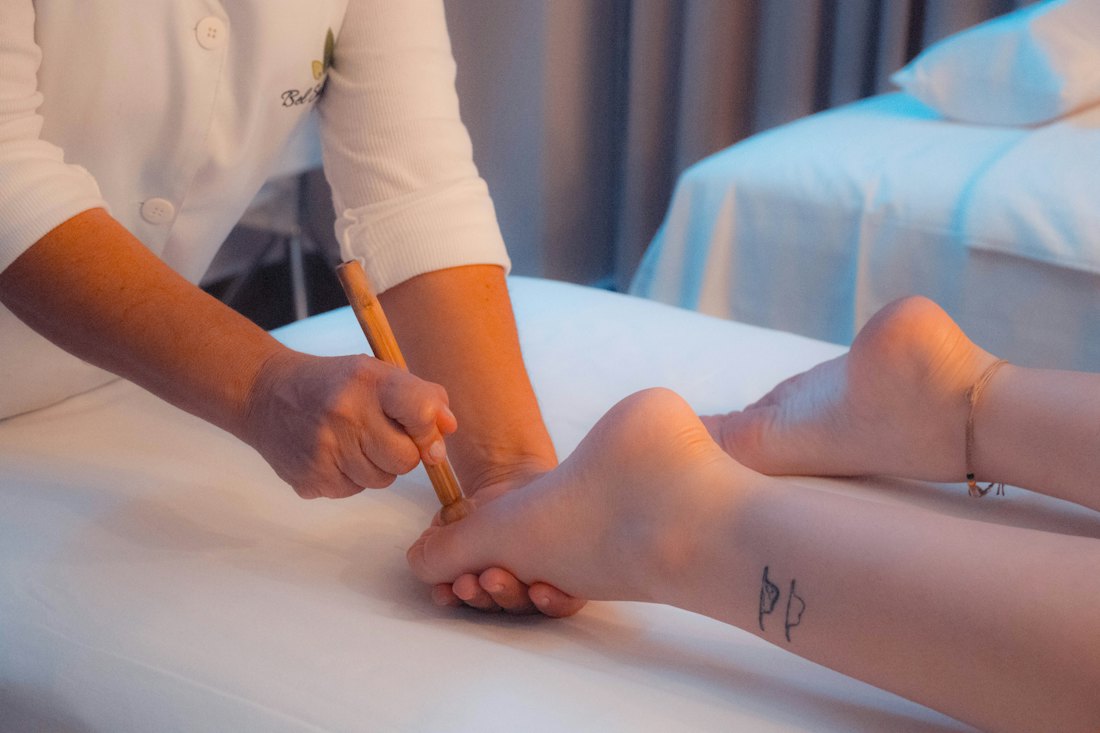
- Tui Na is physically demanding manual work: body mechanics, sustained pressure and repetitive movement.
- All clinical programmes require the emotional capacity to work with people who are unwell, in pain or distressed.
Educational content notice
Content on this website describes Chinese medicine as it is taught and practised historically and is provided for educational purposes only. It is not medical advice and is not intended to diagnose, treat or cure any condition. Always consult a qualified healthcare professional about your own health, and never delay or stop conventional treatment because of something you have read here.
Access & support
Disability, specific learning differences and support
Disability is read broadly: it includes specific learning differences such as dyslexia, dyspraxia, dyscalculia and ADHD, long-term health conditions, mental health conditions, autism, and sensory or mobility impairments. You do not have to be certain about a diagnosis to talk to us about support.
Please disclose early. Tell us at application — there is a section for it in the applicant portal — or email admissions at any point before teaching begins. Adjustments take time to arrange well: examination arrangements have deadlines, alternative formats have to be produced, and practical teaching may need different equipment or a different room. Disclosure is confidential, is shared only with the staff who need it, and does not affect the decision on your application.
Where a professional standard cannot be met even with adjustments, we will tell you honestly and discuss the alternatives rather than let you start a programme you cannot complete. In practice this is rare, and it is a conversation, not a decision made about you.
What support can look like
Assessment arrangements
Additional time, a separate room, rest breaks, a reader or scribe, or adapted practical assessments where the standard being tested allows it.
Materials in accessible formats
Lecture notes, handouts and reading lists supplied in advance and in the format you need — large print, plain text, or a screen-reader-friendly version.
Recording and note-taking
Recorded lectures are available to all students, and note-taking support can be arranged where a learning difference makes live note-taking unreliable.
Practical teaching adjustments
Table height, seating, lighting, rest breaks, adapted equipment and additional demonstration time in practical sessions.
A named contact
One person who knows your circumstances and coordinates your support across tutors and the clinical office, rather than you having to explain it repeatedly.
Study skills and mentoring
Support with academic writing, revision strategy, time management and exam technique, arranged around a part-time timetable.
To arrange support we may ask for evidence of your needs — a diagnostic report, a letter from a clinician, or a needs assessment from another institution: [EVIDENCE REQUIRED]. Where an assessment would help, we will discuss how it can be arranged. Campus access, parking and facilities for visitors and students are described on the locations page, and the college’s accessibility statement is published in our accessibility policy. If you would like this information, or the prospectus, in large print, plain text or another format, ask us and we will provide it.
Not sure whether you meet the requirements?
Send us your qualifications and work history and we will tell you which programme you are eligible for — or what would make you eligible next cycle. There is no charge for asking.