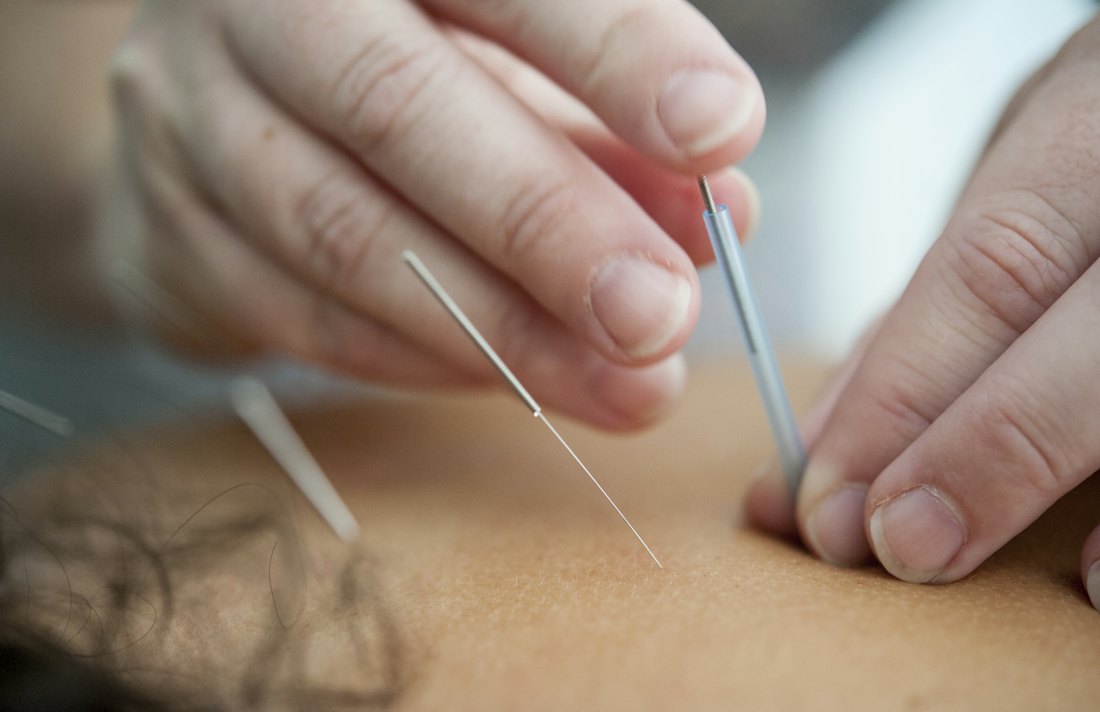
Diploma · Indicative 3 years part-time
Acupuncture & Meridians
针灸学 · Zhēnjiǔ xué
- Level
- Diploma
- Duration
- Indicative 3 years part-time
- Intakes
- September and January intakes (indicative)
- Study mode
- On campus
- Online theory with on-campus practical weekends
Overview
About this programme
Acupuncture is the best-known branch of Chinese medicine in the UK, but the depth behind it is often underestimated. A practitioner is expected to know the pathways of the twelve primary channels and the eight extraordinary vessels, to locate hundreds of points reliably by anatomical landmark, and to choose and combine those points according to a reasoned diagnosis rather than a memorised list.
This programme teaches that reasoning explicitly. You begin with the classical framework — yin and yang, the five phases, qi, blood and fluids — and build outwards into channel pathways, point categories, needling technique, and the treatment of common presentations. Hands-on practice is introduced early and repeated throughout, because point location is a physical skill, not a fact to be memorised.
The college teaches needling within a supervised teaching clinic environment. Students do not needle members of the public unsupervised at any stage, and all practice sessions follow the college's infection prevention and sharps handling policy.
Fees are available on enquiry. The college publishes fees on request rather than in a table, so that we can explain what each figure covers — tuition, assessment, materials and any clinical costs — and discuss payment by instalments. See Fees & funding or enquire directly.
Who it's for
Is this programme right for you?
- Career changers who want to practise acupuncture professionally in the UK
- Healthcare professionals — physiotherapists, nurses, midwives — extending their scope of practice
- Existing practitioners from related disciplines who want a rigorous grounding in channel theory
- Massage and manual therapists who want to add needling to an established practice
Learning outcomes
What you will be able to do
- Describe the pathways, internal pathways and key points of the twelve primary channels and the eight extraordinary vessels
- Locate and needle the core point repertoire accurately by anatomical landmark, and explain the rationale for each point's classical actions
- Take a structured Chinese medicine history — tongue, pulse and the four examinations — and arrive at a reasoned pattern differentiation
- Construct and adjust a treatment plan, and explain your point selection to a supervisor or a patient in plain English
- Apply needling safely: correct depth and angle, contraindications, adverse event recognition, and immediate response procedures
- Maintain contemporaneous clinical records, including consent, treatment notes and adverse event reporting
- Understand the limits of your competence and the referral pathways that follow from them
Curriculum
Programme structure
| Stage | Module | Format | Indicative hours |
|---|---|---|---|
| Year 1 · Foundations | Foundations of Chinese medicineYin-yang and the five phases; qi, blood, body fluids and the organ networks; the concept of pattern differentiation; an introduction to classical texts and to the history of Chinese medicine in the UK. | On campus + online theory | Indicative [XXX] hours |
| Year 1 · Foundations | Meridians and surface anatomyChannel pathways and internal pathways; surface anatomy relevant to safe needling; location of the primary point categories by anatomical landmark. | On campus, practical | Indicative [XXX] hours |
| Year 1 · Foundations | Diagnostic skills: tongue observationStructure of the tongue, what each region reflects, and how to build a consistent and repeatable observation habit rather than an impressionistic one. | On campus, practical | Indicative [XX] hours |
| Year 2 · Technique | Needling technique and point combinationsInsertion angle and depth, needle selection, deqi, sedation and tonification, retention time, electroacupuncture fundamentals, and the classical rules governing point combination. | On campus, supervised practice | Indicative [XXX] hours |
| Year 2 · Technique | Pulse diagnosisThe three positions and nine regions, qualities and their interpretation, and the discipline of corroborating pulse findings against the rest of the presentation. | On campus, practical | Indicative [XX] hours |
| Year 2 · Technique | Treatment of common presentationsStructured treatment approaches for musculoskeletal pain, headache and migraine, stress and sleep disturbance, digestive complaints, and women's health presentations — framed as what Chinese medicine observes and does, not as claims of cure. | On campus + online theory | Indicative [XXX] hours |
| Year 3 · Practice | Supervised teaching clinicReal consultations under supervision, from intake and diagnosis through to needling, record-keeping, aftercare advice and follow-up planning. All patients are consented and all treatments are supervised. | On campus, supervised | Indicative [XXX] hours |
| Year 3 · Practice | Professional practice, ethics and regulationSetting up a practice, standards of conduct, consent, record-keeping and data protection, insurance, safeguarding, the current UK regulatory position for acupuncture, and how to handle a complaint. | On campus + online | Indicative [XX] hours |
Admissions
Entry requirements
- Aged 18 or over at the start of the course
- Evidence of study at Level 3 or equivalent, or relevant prior professional experience
- For applicants whose first language is not English, evidence of English proficiency sufficient to study at this level
- A satisfactory enhanced DBS check before entering any supervised clinical element
- Completion of the college's pre-course health and safety induction, including blood-borne virus awareness
- No prior experience of Chinese medicine is required for Year 1 entry
Full details, including how to evidence each requirement and how we handle applications from outside the UK, are on the entry requirements page.
Assessment
How you will be assessed
- Point location examination — practical, unseen, assessed by an external examiner
- Written papers on theory, channel pathways and pattern differentiation
- A case-study portfolio built during the supervised teaching clinic
- Practical needling assessment against a published safety and technique checklist
What you can do afterwards
- Chinese Herbal Medicine — for practitioners who want to prescribe as well as needle
- Advanced CPD short courses in specialist clinical areas
- Membership of a professional body and entry onto a voluntary register, where requirements are met
Next steps
Applying for this programme
Step 1
Enquire or attend an open day
Ask us anything before you commit. Our open days include programme talks and a visit to the teaching clinic.Step 2
Check the entry requirements
Make sure you can evidence each requirement. If you are unsure about a qualification, ask us before applying — we assess prior experience as well as formal certificates.Step 3
Complete the online application
Applications are made through our online form. You will be asked for your details, your prior study, and a short statement about why you want to study this programme.Step 4
Conversation and offer
Most applicants are invited to a short conversation, in person or online. Offers are made after that, and include the fee schedule and payment options.
Questions
Frequently asked questions
Do I need to be able to speak Chinese?
No. All teaching is delivered in English. However, we teach the standard pinyin and where useful the Chinese characters for key terms, because the terminology carries meaning that translations flatten. Students consistently find this helps rather than hinders.
How many contact hours are there?
Exact contact-hour figures are being finalised and will be published here once confirmed. The indicative distribution across theory, practical and supervised clinic time is shown in the curriculum table above.
Will I be needling real patients?
Not on your own, and never without supervision. Practical work begins with your own student group under close supervision. Contact with members of the public happens only in the supervised teaching clinic, with written consent, and always with a qualified supervisor present.
Is acupuncture regulated in the UK?
Acupuncture is not currently statutorily regulated in the UK, so practitioners are not required by law to hold a licence in the way that, for example, doctors are. Practitioners work to professional standards set by their professional body and are expected to hold appropriate insurance. The college teaches to those standards and explains the current position fully during the professional practice module.
Can I study while working?
Yes — this is designed as a part-time programme, with theory delivered online and practical teaching concentrated into on-campus weekends and blocks. Most students continue in employment throughout.
Related study
You may also be interested in
Chinese Herbal Medicine & Materia Medica
A systematic study of the Chinese materia medica: how individual herbs are classified and understood, how classical formulae are built, and how prescribing is done safely and responsibly.
View programme
Tui Na — Chinese Therapeutic Massage
A practical programme in Chinese therapeutic massage: the hand techniques, the channel and joint work, and the clinical reasoning that turns a sequence of movements into a treatment.
View programme
Enquire
Ask about Acupuncture
Educational content notice
Content on this website describes Chinese medicine as it is taught and practised historically and is provided for educational purposes only. It is not medical advice and is not intended to diagnose, treat or cure any condition. Always consult a qualified healthcare professional about your own health, and never delay or stop conventional treatment because of something you have read here.
Placeholder information
Fees, exact dates, contact hours, module titles and the awarding arrangement for this programme are pending confirmation and are marked as placeholders throughout this site. Nothing on this page should be relied upon as a contractual commitment until the college publishes its validated programme specification.
Ready to apply for Acupuncture?
Applications are open for the next intake. If you would rather talk it through first, we are happy to do that too.